SUCCESS STORY
High-Performance Transparent Armors
Industry
Defense & Military
Client
U.S. Army Natick Soldier Systems Center
Tech
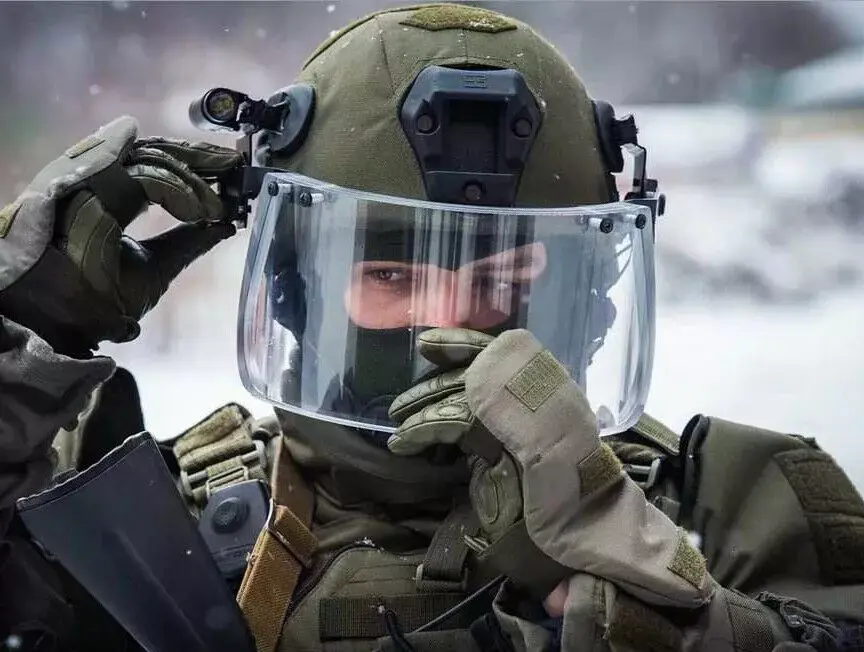
Medium Protection Face Shield
Dev Time
12 months
Release Date
October 10, 2024
Transitioning From R&D Efforts To The Fielding And Commercialization Of Innovative Lightweight And Superior Ballistic Resistant Transparent Armor Material Technology


WHAT ARE THE CHALLENGES?
Conventional transparent armor materials used for soldier facial protection are made of either polycarbonate or polycarbonate/polymethylmethacrylate hybrids. Although these materials provide satisfactory protection, their ballistic performance is significantly inferior to conventional fiber-reinforced composite materials. This major difference in protective capabilities is critical as ocular adnexal injuries occur frequently. Therefore, the U.S Army has an urgent need to resolve this problem and provide better protection for soldiers.
The U.S. Army adapted a new armor idea for Iraq in 2006, the Cupola Protective Ensemble (CPE), a medium protection face shield (MPFS) designed to provide turret gunners with better facial protection. To perform their role, turret gunners need to have the best view of their surroundings, which unfortunately also exposes them to explosions and enemy firearms. Due to the exposed nature of their position, turret gunners are considered to have the most dangerous jobs in Iraq, with the highest casualty rate.
Even though CPEs provide better ballistic protection, there are two major drawbacks associated with them. The first being that they are extremely insulating, causing gunners to overheat and forcing them to remove their CPE before heat stroke kicks in. This is especially problematic in hot and arid climates such as Iraq. The second drawback is the CPEs’ weight and bulkiness, which restricts the movement of turret gunners, decreasing their combat effectiveness. Gunners in CPEs are slower to react to threats and tire quickly. Therefore, there is an urgent need to achieve the U.S. Army’s goal of providing better facial protection for our soldiers.

FPP DEFENSE’S NEW PRODUCTS
By utilizing the innovative super-high strength polymer material (SHSPM) technology developed over the past 20 years, FPPD has successfully developed and demonstrated its own medium protection face shields (MPFS), spectacle lenses, and goggle lenses. The use of SHSPM technology allows the final product to provide better protection while reducing the weight burden to our soldiers.
FPPD’s MPFS provide critical improvements on some of the major issues associated with current CPE. They reduce the face shield’s weight by 40% (2.1 lbs vs. 3.5 lbs), provide higher ballistic resistance (1600 fps vs. 1450 fps) for the first generation MPFS, and are expected to be further increased to more than 1800-2000 fps for the upcoming generations. With these improvements, turret gunners will have enhanced protection, improved mobility and better stamina. Other benefits of FPPD’s MPFS include a larger protection area, better multi-shot capabilities, higher light transmittance for better night vision, and more.
FPPD’s high-performance spectacles have a significantly higher ballistic resistance than the currently fielded spectacles. While achieving 12% weight savings using the Army’s existing spectacle configuration, FPPD’s 1st generation spectacle has a V0 in the range of 1050-1100 fps compared to 800 fps for Army fielded spectacle. Furthermore, with the new super-high strength polymer material production line in place, FPPD expects the V0 to reach 1400-1500 fps with future generations.
Since more than 80% of ocular injuries in combat are caused by fragments from munitions, the significantly higher ballistic resistance of FPPD’s spectacles, goggles, and MPFS can significantly reduce ocular injuries and meet the US Army’s priority of providing better protection and increasing the survivability of U.S. soldiers.
Once FPPD’s new production line becomes operational, the ballistic performance of the future generations of these novel high-performance materials can further reduce the ballistic performance gap to the UHMWPE fiber composite materials, but at a much lower cost (as low as 10-20% of Dyneema or Spectra composite materials). The lower cost nature of these higher performance armor materials will allow US Army to provide more extensive and highly effective protection to our solders. The advance on this high-performance lightweight transparent armor material technology will allow FPPD to support the US Army’s priority of providing better protection to enhance the survivability for our warfighters.
FIELDING AND COMMERCIALIZATION EFFORTS
The U.S. Military needs armor protection for personnels, vehicles, structures, etc., and these armors have been traditionally constructed using Kevlar aramid fiber composites, or more recently by Spectra or Dyneema UHMWPE fiber composites. Although these composite materials provide excellent ballistic and blast resistance, they are expensive and in limited supply.


The original fibrous structures that the fiber composites are made from have relatively inefficient energy absorption. For them to be effective they must be drawn to super high strength, around 3-4 gigapascals, which is very costly. The high cost of these armor materials may limit their usage for general protection of personnel, vehicles and structures.
FPPD’s super-high strength polymer material is not fibrous in structure but instead is a bulk-structured material, allowing it to have much higher energy absorption efficiency. Ballistic test results has confirmed that the performance of FPP Defense’s first-generation armor material is already better than Kevlar aramid fiber or S-glass composite material. Once FPPD’s new production line becomes operational, the ballistic performance of next-generation high-performance materials can match that of UHMWPE fiber composites, but at a much lower cost – potentially as low as 10-20% of the cost of Dyneema or S-glass composites). Reducing the cost of these higher performance armor materials will allow the U.S. Army to provide more extensive and highly effective protection to our solders.
With the new production line coming online, FPPD is collaborating with DOD stakeholders to field the super-high strength polymer material technology for HPFS and vehicle transparent armors, including the heavy glass armor replacement for gunner protective kits. FPPD is also working with commercial partners to bring ballistic face shields for NIJ HG2 or RF1 protection and fully transparent handheld ballistic shields to the civilian law enforcement market.